TenantTalks Fireside Chat Buzz, Belonging and Buy-In: From Proximity to Purpose Recap
On October 30, 2025, leaders from across Western Canada's workplace, design, and business communities gathered at the Fairmont Pacific Rim for TenantTalks: Make Space – The Evidence Behind Experiences That Bring People Back.
During the event, Elizabeth Christie, Senior Manager of Workplace Experience at AbCellera, joined Robin Rosebrugh, Director of Workplace Strategy and Research at Aura, for a thought-provoking fireside chat on the role of agency, autonomy, and intentional programming in creating meaningful workplace experiences. Their conversation examined how flexible work policies, community-building initiatives, and targeted programs can promote engagement, belonging, and trust within global teams.
Continue reading to learn the main takeaways and highlights from the conversation. For additional perspectives, readers can also review our panel discussion recap or watch the video recordings of the event.
Setting the Scene: Learning about AbCellera
Elizabeth Christie provided an overview of AbCellera's workforce and hybrid approach, noting that the company has three offices in Vancouver, as well as smaller offices in Montreal and Sydney, Australia, with approximately 1,200 employees based in Vancouver. Despite not having a formal hybrid mandate, occupancy from Tuesday to Thursday averages about 80%, reflecting strong engagement and community interest. AbCellera's flexible workplace policy empowers employees to choose how and where they work, emphasizing the importance of agency.
Robin Rosebrugh contextualized the concept of agency through self-determination theory, emphasizing the importance of autonomy, belonging, and competence. By designing flexible work policies around these principles, AbCellera enables employees to feel both empowered and connected, while addressing potential challenges of remote work, such as isolation or disengagement. She highlighted three distinct types of agency that give employees meaningful control over how, when, and where they work:
- Space-based agency – offering options for different work environments (not just between the home and office, but control within the office as well)
- Time-based agency – allowing employees to work during their most productive hours.
- Task-based agency – giving employees choice in how they accomplish their work.
Question 1: AbCellera's job postings say "you'll find we prioritize teams and social groups to build community and connections across AbCellera." That line really stands out. It suggests that community isn't just an add-on, but it's truly built into how you work.
What does that philosophy look like in practice? How do teams and social groups actually build community across such a fast-growing organization?
Elizabeth explained that it starts with intentionality and clarity of purpose. One of AbCellera's core values, team first, anchors their approach, ensuring that every initiative reinforces a shared vision of collaboration and belonging. Rather than dictating social programs from the top down, AbCellera empowers employees to create their own groups, ranging from ping pong clubs and running groups to "Sit and Stitch" circles, while providing the operational support and visibility needed to help them thrive.
Digital signage throughout the workplace highlights these community-led initiatives and celebrates team achievements, creating organic "seeds of conversation" that spark new connections and cross-functional understanding. Robin Rosebrugh added that this approach represents a modern evolution of personal connection, much like the trinkets and photos employees once displayed on their desks. These shared interests and grassroots groups now serve as new anchors for belonging, fostering authentic relationships and a sense of agency rather than "managed fun" imposed from above.
Together, they painted a picture of a workplace where community grows organically but intentionally, supported, visible, and deeply rooted in shared purpose.
Question 2: What kinds of intentional programs or traditions have you implemented to strengthen connection or belonging across teams?
When discussing the intentional programs and traditions that strengthen connection and belonging across teams, Elizabeth shared how AbCellera blends structured leadership development with creative, people-centred initiatives.
One key example is their Manager Studios, cross-functional forums that bring managers together to exchange feedback, share challenges, and build relationships beyond their immediate teams. These sessions not only foster collaboration and empathy among leaders but also serve as a "test studio" for the People & Culture team to understand the real impact of policies across the organization.
Beyond leadership initiatives, AbCellera also creates shared experiences that connect people through everyday moments. Elizabeth highlighted how the team refined their summer food truck program to be more intentional—scaling back options and encouraging employees to "bring a friend" to lunch, which led to deeper interaction and stronger community ties. Similarly, their bike tune-up lessons evolved from a simple service into a collaborative learning experience, allowing employees to connect through shared interests while building trust outside of work projects.
Robin Rosebrugh expanded on this, explaining that these experiences cultivate affect-based trust —a form of rapport built through shared experiences and genuine connection —which research shows is more complex to break and strengthens teamwork. She also noted the "friendship paradox," where inviting someone to "bring a friend" naturally extends social networks, helping culture and connection spread more organically throughout the organization.
Together, these examples demonstrate how thoughtful, human-centred programming, both structured and spontaneous, can deepen belonging and strengthen the social fabric of a workplace.
Question 3: What role do smaller, organic moments—like informal chats or rituals—play alongside those larger structured initiatives?
When it comes to fostering authentic connection, Elizabeth emphasized that smaller, organic moments are just as impactful as large-scale initiatives. At AbCellera, these moments often take shape through programs and rituals that feel natural and human, like their buddy programs and Toasty Tuesdays.
The company operates two versions of its buddy system: one that pairs new hires with volunteers to help them navigate their first weeks and feel grounded from day one, and another that is open to all employees, connecting people across global offices. These casual pairings often blossom into lasting friendships, some of which last for years, and help build instant trust and familiarity across teams and geographies.
Meanwhile, Toasty Tuesdays, inspired by their Australian office's "Toasted Tuesdays," have become a beloved weekly ritual in Vancouver, where employees gather over coffee and breakfast toast to chat, connect, and share updates. These gatherings not only celebrate global connections but also create space for spontaneous conversation and cross-team visibility. As Elizabeth noted, such informal touchpoints, though seemingly simple, play a decisive role in reinforcing belonging, sparking collaboration, and humanizing the workplace experience.
Question 4: How do you currently evaluate the success or impact of your programs—either formally or intuitively?
Elizabeth emphasized that measurement is a combination of science and intuition. While the team uses traditional metrics, such as engagement survey results and occupancy data, some of the most meaningful insights come from observing behaviour, interaction quality, and the speed at which teams can collaborate.
She highlighted their Scientific Seminars as an example: success isn't measured by how many people showed up, but by who attended (the range of teams represented) and, more importantly, the quality of questions asked. Are people curious? Confused? Sparking debate? Or is silence signalling either total clarity or a missed connection?
Leadership participation also adds another layer of impact, showing employees that their work is valued. Elizabeth also noted a powerful intuitive metric shared by a People & Culture colleague: the speed at which challenging, complex problems can be solved. When teams already have trust and rapport built through meaningful programming, they can bypass early-stage relational hurdles and move straight into productive problem-solving.
While not always easily quantifiable, these faster collaboration cycles are a real indicator of ROI, demonstrating that connection-building efforts ultimately lead to more efficient, resilient, and high-performing teams.
Question 5: How has your programming evolved in this new space compared to your previous office, in terms of the types of gatherings, frequency, or energy they create?
Elizabeth Christie explained that AbCellera's move into a larger, multi-floor workplace required a fundamental shift in how programming and connection are supported. In their previous, smaller office, collaboration occurred naturally through proximity, but in a larger environment, connection must be intentionally designed.
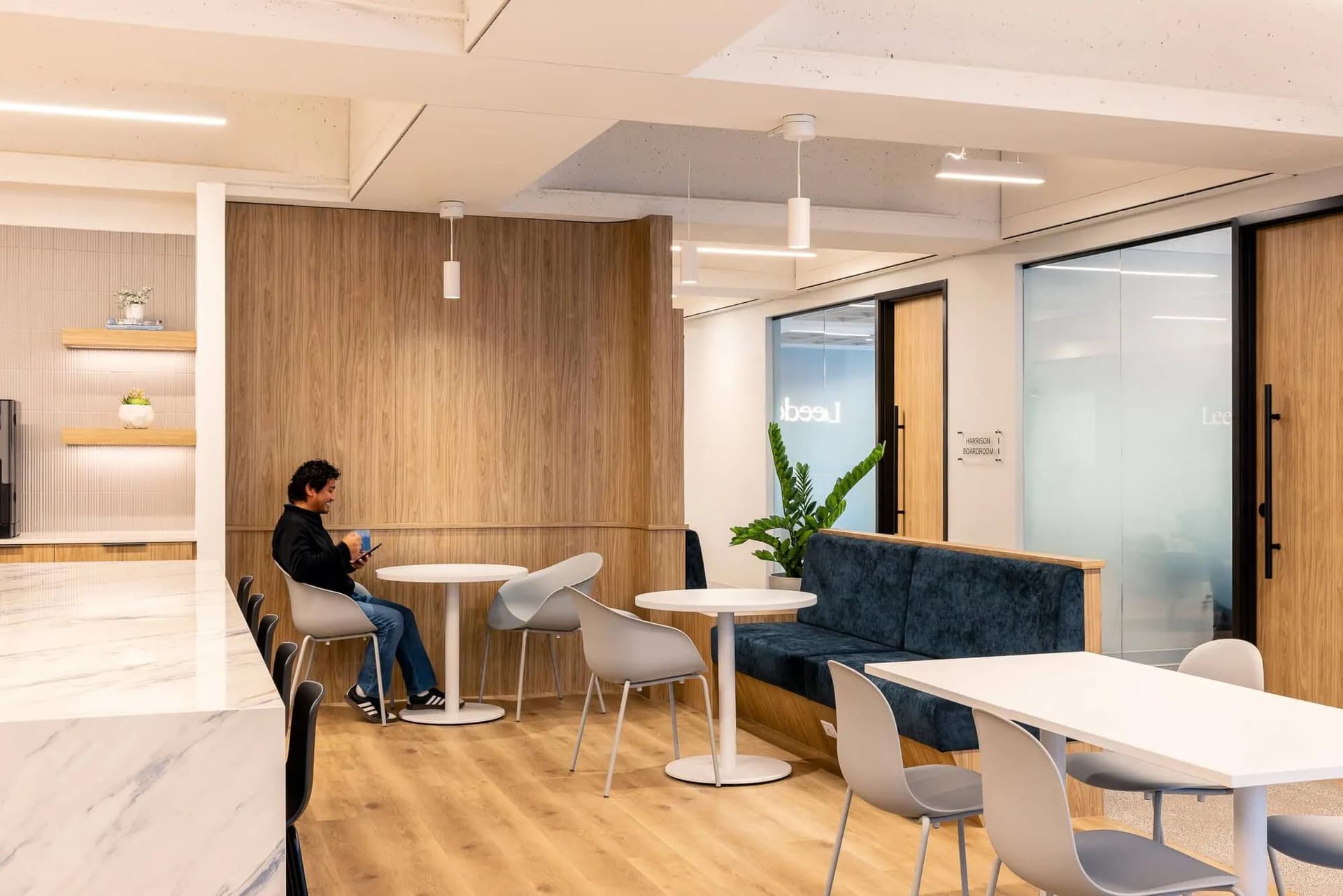
The new, larger office has led to a stronger focus on space planning that encourages intentional collisions. Elizabeth referenced a favourite idea: "functional inconvenience equals intentional connection," meaning the team strategically centralizes key amenities, such as offering particular food or events only in one large kitchen, to draw people together rather than dispersing them across floors.
Design elements such as centralized, inviting stairways, varied kitchen experiences, and thoughtfully furnished communal zones also create natural gathering points. At the same time, AbCellera has struck a balance between openness and psychological comfort by incorporating small, semi-enclosed focus areas where people can choose seats that feel safe while still being part of the larger office energy. Overall, the evolution of programming in this new space is deeply tied to how the environment itself shapes notions of belonging, movement, and spontaneous interaction.
Question 6: What do you want people to take away today?
Elizabeth Christie emphasized that the key takeaway from the discussion is the importance of intentionality and care in designing the workplace experience. She highlighted that small and large gestures, whether it's a gym, a lunchroom, or other amenities, contribute to employees' sense that the organization cares about them, even if they don't directly use every offering. Robin added that this aligns with the concept of perceived organizational support, where improvements to the office environment enhance employees' feelings of being valued.
Elizabeth concluded by stressing that the ultimate goal is for people to feel valued and empowered to create their own sense of purpose, noting that happiness and engagement are driven by feeling valued and helping others. In essence, effective workplace programming is about aligning organizational intent with opportunities that allow employees to experience connection, recognition, and meaning in their work.
About TenantTalks
TenantTalks is a global nonprofit speaker series focused on the ways of working that are impacting how organizations function today and in the future. Featuring speakers from various industries, disciplines, and locations worldwide, our educational events bring leaders together to discuss their personal experiences, challenges, and ideas on the use of the office and the evolving ways we work.
With the simple goal of providing a platform for collectively shaping the office of the future, TenantTalks operates as a nonprofit project. All proceeds from ticket sales are donated to charities worldwide dedicated to making a difference in our communities.
We are grateful for your contributions to this enriching learning experience and invite you to our next event for further insightful discussions. We look forward to seeing you at our next event!